

Casino loyalty points are calculated from theoretical loss, which represents what the maths says the house expects to win from your play over time. They track expected casino revenue independent of whether you won or lost. Every comp point, every tier upgrade and every “VIP” perk sits on this calculation.
Slots earn more points than table games because of their house edge. Tiers can quietly disappear mid-year. UK loyalty programmes today look entirely different from schemes on overseas sites.
What theoretical loss actually means
The industry formula is commonly known but rarely advertised. The calculation is straightforward.
Theoretical Loss = Average Bet × Hands or Spins per Hour × Hours Played × House Edge
Four inputs make up this calculation. They are average bet, hands per hour, hours played, and house edge. Whether you won or lost does not factor in. Comps are calculated before the result of your session is known. The operator prices your expected contribution to the house’s margin based on these inputs alone.
Put £1,000 of turnover through a game with a 1.5% house edge and your theoretical loss is about £15. The typical comp-back rate returns a percentage of that theoretical figure as bonus credit, free play or points.
At a 20% comp-back rate, the maths is simple. £15 of theo becomes roughly £3 of comp value. That £3 is the whole transaction. Everything else in a loyalty programme (the tiers, the badges, the birthday offers) wraps around this basic percentage of expected loss.
If two players wager the same amount, why do they earn wildly different point totals?
Why slots and table games earn at different rates
Points track expected revenue. A pound wagered on a low-edge table game generates far less expected revenue than a pound wagered on a slot. The same pound therefore buys far fewer points.
The commonly cited figures show roughly a fivefold gap between the two. Slots typically offer around 20 points per $100 wagered, while table games earn around 4 points for the same amount. The general range for slots runs from about $10 up to roughly double that per point, with table games requiring substantially more turnover for equivalent reward.
The points system weights rewards in proportion to a game’s house edge, which is exactly what it was designed to do. A slot spin represents more expected casino revenue per pound staked than a blackjack hand played with basic strategy. The loyalty scheme is fundamentally a revenue-sharing mechanism that shares in proportion to expected revenue.
When your goal is tier progress, the game you choose changes your earning rate multiplicatively. Two players with identical bankrolls and identical session lengths can end the month in different tiers purely because of what they played.
Tier multipliers: the same formula, turned up

Higher tiers earn points faster. Elite tiers typically give 25% to 50% extra point accumulation over the base rate. The structure usually has three broad bands. An entry tier that anyone gets on sign-up is the base level. A mid tier is earned through sustained play. A top or VIP tier is invitation-only or requires serious volume. Promotion between them is driven by cumulative points or wagering volume within a set period. Programmes also run time-limited multiplier promotions that boost the base rate substantially for a defined window, often tied to a specific game or day.
A multiplier promotion does not change the underlying arithmetic; it changes how quickly turnover converts into tier progress. If points are priced off theoretical loss, a multiplier makes the effective return substantially higher during that window (which is generous, and why those windows are short and heavily restricted).
Always read the terms on a multiplier before chasing it. A 5x boost that applies only to one game type, on one day, with a points cap is purely a marketing event that leaves your underlying earning rate untouched.
How you lose a tier without noticing
Most players assume a tier, once earned, is permanent. For most programmes, it works more like a subscription. Two models dominate this approach. Under a rolling-period system, the points you earned in the trailing months determine your current tier, so status reflects recent play while older points stop counting. Under a calendar-period system, status is reviewed at set intervals against a fixed window that then resets.
Points themselves commonly expire after extended periods of inactivity. Tier status can drop at the next scheduled review if your wagering falls below the maintenance threshold. A typical pattern occurs like this: you hit a tier in autumn, play heavily through winter, then ease off in spring. By summer review, the trailing window no longer contains enough qualifying activity and your tier drops. The perks you’d come to expect (the faster earning rate and the extras that came with the tier) quietly stop.
The maintenance threshold is the critical number to track before chasing a tier. While qualification gets you in, maintenance keeps you there. Maintenance is usually the harder figure to find in the small print.
What changed for UK players in 2020
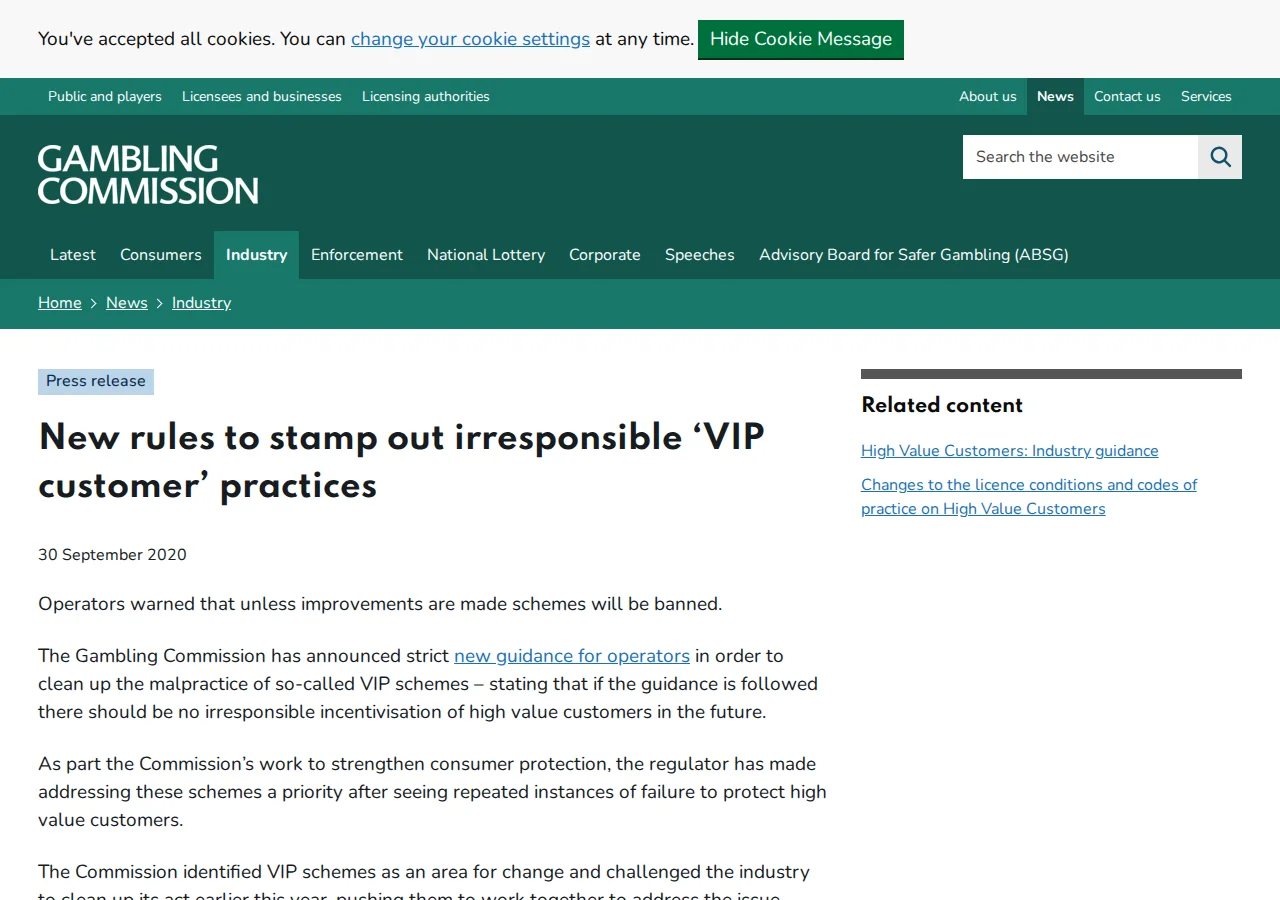
UK loyalty schemes differ sharply from what you read about on offshore sites. In October 2020, the UK Gambling Commission introduced a code of conduct, developed with the Betting and Gaming Council, targeting “VIP” and high-value-customer schemes. The regulator acted after evidence linked those schemes to gambling harm and, in some cases, to money laundering. Every GB-licensed operator must now follow these rules:
- Quarterly affordability and enhanced due-diligence checks on VIP scheme members.
- A named senior manager holding a Personal Management Licence, personally accountable.
- No incentivising customers based on their losses.
- No enrolment of anyone under 25 into VIP or loyalty schemes.
The effect was substantial. The number of active VIP and high-value-customer schemes fell dramatically per operator after the reform. A later Gambling Commission review found no resurgence.
When you see a loyalty programme advertised by a GB-licensed brand today, you are looking at a constrained, compliance-shaped system. The aggressive loss-based incentives that once defined VIP schemes elsewhere (where a player’s comp rate could rise as their losses did) are precisely what the regulatory code outlawed. Points still accrue and tiers still exist, but the mechanism can no longer reward increased losses.
This matters for how you read any loyalty offer. If a scheme’s rewards scale upward with losses, you’re looking at an unlicensed product that lacks these safeguards, including GAMSTOP nationwide self-exclusion. The same applies to bonus credit earned through points. Such credit is bonus money, and a bonus’s wagering requirements show what the points are worth.
The arithmetic, summarised
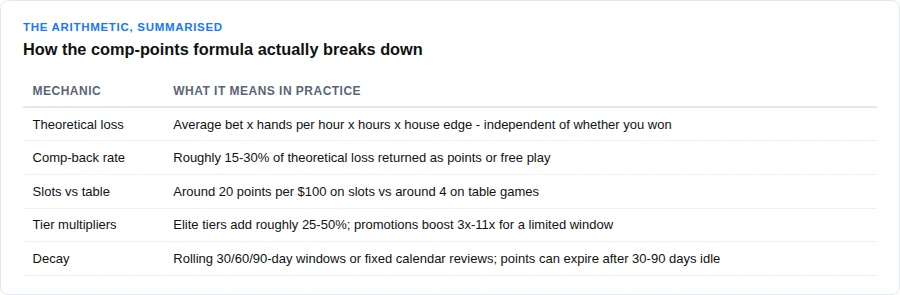
| Mechanic | What it means in practice |
|---|---|
| Theoretical loss | Average bet × hands per hour × hours × house edge. Independent of whether you won |
| Comp-back rate | Roughly 15–30% of theoretical loss returned as points or free play |
| Slots vs table | Around 20 points per $100 on slots vs around 4 on table games |
| Tier multipliers | Elite tiers add roughly 25–50%; promotions boost 3x–11x for a limited window |
| Decay | Rolling 30/60/90-day windows or fixed calendar reviews; points can expire after 30–90 days idle |
Loyalty schemes are fundamentally a pricing mechanism with a marketing layer on top. The pricing mechanism becomes legible once you know which four numbers feed it.
What this means for your money
Chase the earning rate over the tier name. A mid tier with a generous multiplier on your favourite games beats a top tier reached by playing something you don’t enjoy at a worse rate. Check the maintenance threshold before committing to a tier run. If the trailing window is longer than a few months and your play is seasonal, you may be paying for status you’ll lose before using it. Treat comps as a partial rebate on expected loss, not a profit opportunity.
A reasonable comp-back rate on a low-edge game softens the cost of play you were going to fund anyway. The house edge still applies to every pound staked. The comp arrives afterwards, in points, at the operator’s valuation.
Loyalty programmes make sense if you understand them. They become expensive if you chase them without understanding the mechanics.
FAQ
Are casino loyalty points based on how much I win or lose? Neither. They are based on theoretical loss, which is your average bet multiplied by hands or spins per hour, hours played and the game’s house edge. Your actual result does not enter the calculation.
Why do slots earn more points than table games? Points are weighted in proportion to house edge. A pound wagered on a slot produces more expected revenue for the operator than a pound wagered on a low-edge table game, so it earns more points. Slots typically offer roughly five times the earning rate of table games for the same wagering amount.
Can I lose a tier I’ve already earned? Yes. Most programmes review status against a rolling window or a fixed calendar period. If your qualifying play falls below the maintenance threshold by the review date, your tier drops. Points can also expire after extended periods of inactivity.
Can a UK-licensed casino reward me more when I lose more? No. Under the regulatory code, GB-licensed operators cannot incentivise customers on the basis of their losses, must run quarterly affordability checks on VIP scheme members, and cannot enrol anyone under 25. Active VIP schemes fell by roughly 95% per operator after the reform.
Do tier multipliers change the underlying maths? They change how fast turnover converts into points while keeping the formula constant. A multiplier promotion speeds up tier progress during its window. The base earning rate, set by theoretical loss and the comp-back percentage, remains unchanged.
Gambling is for adults only (18+). If your play stops feeling like a choice, support is available through GAMSTOP and the National Gambling Helpline.